
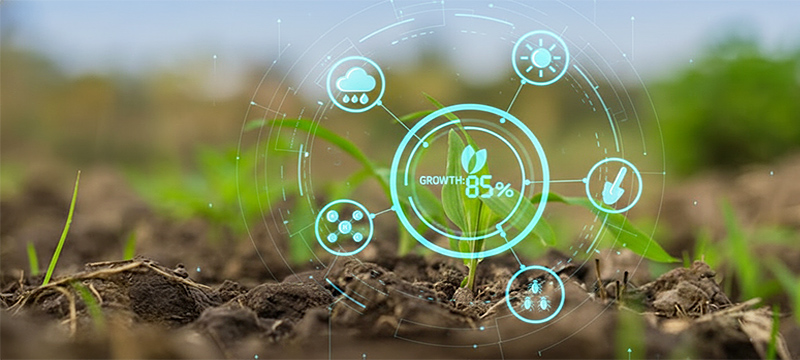

From climate volatility to labour shortages and rising input costs, agriculture is under acute pressure to become more predictable, more automated and more resource-efficient. By 2026, connected sensing, robotics and precision data platforms will move from pilot projects to core elements of farm operations. Yet their impact depends heavily on the economics of connectivity — a decisive factor shaping adoption, business models and long-term value creation.
Soil intelligence becomes the new baseline
Soil monitoring has matured significantly in the past three years. While early solutions offered coarse indicators (moisture, temperature, EC), 2025 deployments integrate dense sensor arrays combined with more sophisticated analytics running at the edge.
Modern probes now support multi-parameter measurement — including nutrient levels, salinity, pH and carbon sequestration markers — feeding decision engines directly embedded in gateways or farm management systems. These real-time insights are improving irrigation optimisation, fertiliser micro-dosing, early stress detection for high-value crops.
The shift from periodic sampling to continuous sensing has reduced waste and improved yields, particularly in water-constrained regions. However, the business case hinges on ultra-low-power IoT hardware and long-range connectivity that keeps operating expenses predictable.
Robotics scales, but integration remains a challenge
Autonomous ground vehicles and robotic implements are increasingly common in specialty crops, vineyards and controlled-environment agriculture. These systems excel at repeatable, labour-intensive tasks — precision spraying, selective harvesting, mechanical weeding and crop scouting.
By 2026, robotics suppliers will focus on safety, interoperability and fleet coordination:
- navigation stacks combining GNSS-RTK, machine vision and local edge compute
- multi-robot orchestration platforms enabling route planning and coverage optimisation
- standardised APIs for synchronising agronomic data with farm management systems
Despite technical progress, integration remains a barrier for mid-size farms. Robotic platforms depend on accurate maps, reliable connectivity and high-quality agronomic datasets — all of which vary widely across geographies. Total cost of ownership also remains sensitive to maintenance, spare parts availability and software subscription models.
Connectivity economics: the keystone of digital farming
The proliferation of sensors, robots and telemetry endpoints has forced farmers and solution providers to reassess connectivity strategies. In 2026, no single network dominates; instead, farms blend multiple technologies based on terrain, density and application criticality.
Key trends shaping connectivity economics include:
- LPWAN consolidation: LoRaWAN and NB-IoT remain dominant for soil and asset monitoring. Costs have stabilised, with module prices continuing to decline and multi-year battery life reducing service overhead.
- Private 5G for autonomy: As licence-light spectrum becomes more accessible, private 5G is increasingly used to support low-latency robotics, video analytics and high-throughput telemetry in large operations.
- Satellite IoT uptake: For remote or fragmented parcels, direct-to-orbit solutions are becoming economically viable thanks to lower device pricing and simplified hybrid terrestrial–satellite architectures.
- Data-driven ROI models: Connectivity is increasingly sold as part of a bundled service — integrating hardware, connectivity, cloud analytics and agronomic insights — shifting the focus from Mbps or messages to measurable outcomes such as water savings, yield uplift or chemical reduction.
Ultimately, the economics of smart agriculture depend less on network specifications and more on how seamlessly data can flow across sensors, machines and farm management platforms.
From experimentation to operational intelligence
The sector is moving beyond standalone digital tools toward integrated workflows where soil sensors trigger irrigation events, robots update crop health indices, and edge analytics filter data before hitting the cloud. This orchestration is enabling more accurate yield forecasting, dynamic input allocation based on real-time conditions, improved traceability from field to processor and stronger resilience to climate variability.
However, value capture remains uneven. Early adopters with large, centralised operations benefit disproportionately, while smallholders often face fragmented solutions and inconsistent connectivity coverage.
Market outlook: towards a more service-centric ecosystem
By 2026, the shift from product sales to service-led models will be accelerating across the agricultural IoT value chain. Connectivity providers are partnering more closely with equipment manufacturers, agronomy platforms and insurers to bundle risk mitigation, operational intelligence and compliance reporting.
The most competitive vendors are those offering vertically integrated stacks combining rugged, low-maintenance field hardware, resilient multi-bearer connectivity, edge and cloud analytics, and open APIs for interoperability with farm management software.
As agriculture confronts an era defined by scarcity — from water to skilled labour — connected systems are becoming foundational infrastructure. The challenge for the industry is to ensure these technologies remain economically accessible, interoperable and resilient at scale.
Conclusion
Smart agriculture in 2026 will be characterised by a deeper fusion of sensing, automation and connectivity economics. Soil sensors and robotics are no longer experimental but integral to operational efficiency. Yet their transformative potential depends on the strategic deployment of cost-effective networks and data platforms. As connectivity models evolve and integrated solutions mature, farmers will increasingly view digital infrastructure not as an optional add-on but as a prerequisite for productivity, sustainability and long-term resilience.
The post Smart Agriculture in 2026: Soil Sensors, Robotics and the Economics of Connectivity appeared first on IoT Business News.